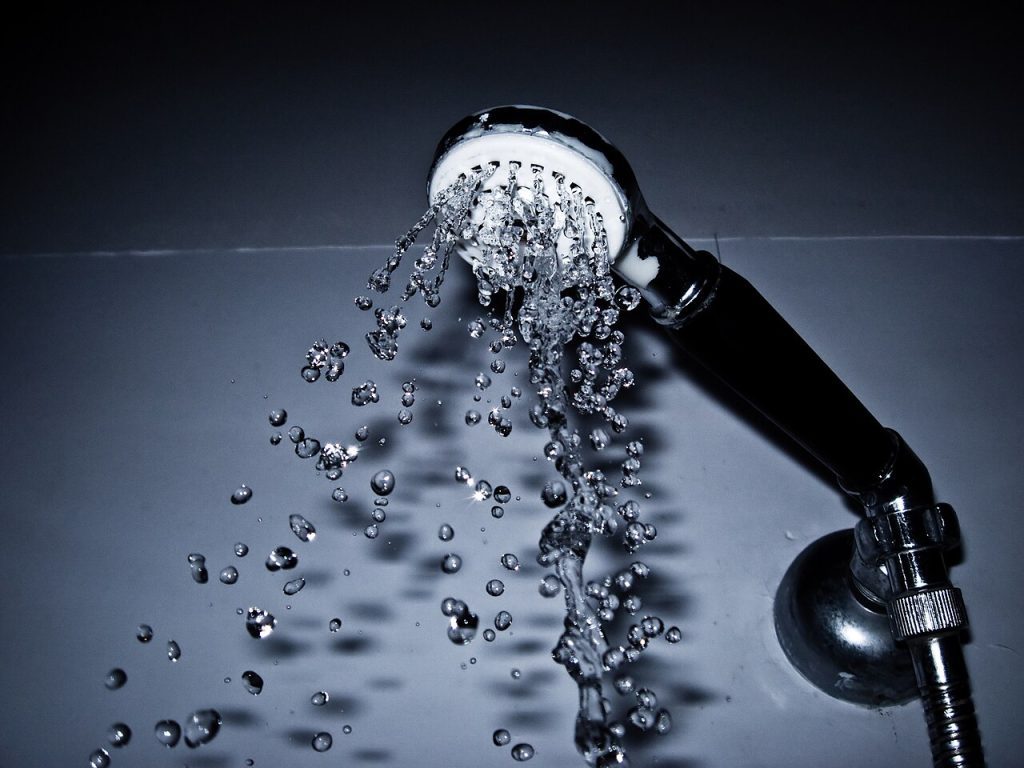
A showerhead does not wear out in a year. It furrs up. If your spray has gone from a full cone to a set of crooked jets that hit the far wall, the holes are almost certainly blocked with calcium and magnesium scale, and the pump is fine. To descale a showerhead properly you need about an hour, a bottle of white vinegar and a bucket for measuring, because the first job is proving the blockage is in the head and not in the plumbing.
Is it scale or actually low pressure?
Scale shows a pattern. The spray is uneven, some jets dribble, some shoot sideways, and the blockage gets worse over months rather than appearing overnight. Real pressure loss looks different: every outlet in the flat suffers, the kitchen tap is weak too, and the flow drops when a neighbour’s pump runs.
Measure it. Hold a 10-litre bucket under the shower, time how long it takes to fill, and divide. A healthy head on a normal household line runs 8 to 12 litres a minute in most Dhaka flats; a scaled head often manages 4 or 5 and sprays them in the wrong directions. Write the number down. You will want it after the soak.
Hard water is the cause. Groundwater across much of the city carries dissolved calcium bicarbonate, and every time a droplet dries on the face plate it leaves a trace of mineral behind. Hard water and the way mineral scale forms is worth five minutes if you want to know why a soft-water flat never has this problem.
Unscrew it and soak it in vinegar
Wrap a cloth round the arm and turn the head anticlockwise by hand. Most are hand-tight. If it will not move, use a strap wrench or a cloth and adjustable spanner, never pipe grips directly on chrome, and be ready for the arm to turn with it, which means resealing the joint with PTFE tape afterwards.
Mix white vinegar and water 1:1 in a plastic bowl, deep enough to cover the face plate. Sit the head face-down in it for 30 to 60 minutes. You will see fizzing and a scummy film on the surface; that is the scale coming off. Do not use boiling vinegar, do not use bleach, and do not leave a chrome-plated head in full-strength vinegar for six hours, because the acid attacks the plating and leaves a dull, mottled finish. Rinse in clean water, dry it, and check the jets.
Citric acid works the same way and smells better. Two tablespoons in a litre of warm water is roughly a 4 percent solution. If you already keep citric acid for descaling an electric kettle with citric acid, use the same jar here, and use ascorbic acid (vitamin C powder) if you want a soak that is gentler on plated finishes.
When the head will not come off
Fixed rain heads and some ceiling-mounted units are not meant to be removed by hand. Fill a sturdy plastic bag with the vinegar mix, pull it up over the head, and hold it with a rubber band or a cable tie round the arm. Leave it 45 minutes, then take the bag off and run the shower hot for a minute. Gravity does the soaking for you, and nothing gets unscrewed.
For the jets themselves, a stiff toothbrush and a pin do the work. Push the pin through each nozzle, wiggle, and rinse. Skip the drill bit and the pressure washer: the face plate is usually thin ABS, and a hole widened by a millimetre turns a jet into a stream. Rubber nozzles on modern heads can be rubbed with a thumb while the water runs, which is the whole point of that design.
The two parts everyone forgets
Scale collects in the inlet filter as well as the face plate. Unscrew the head from the arm and look inside the threaded end; most heads have a small mesh washer and a coloured flow restrictor behind it. Pull both out with tweezers, rinse the mesh, and drop them back the same way round. A clogged mesh cuts flow more than twenty blocked jets ever will.
Then check the hose and the mixer. Hold the hose up to a light and look for a bulging inner tube or a kink at the nut. If the spray is weak at every setting including the handheld position, the cartridge in the mixer is scaled or the strainer washers at the wall unions are blocked, and descaling the head will not fix that. Replacing a shower hose costs less than 300 taka and takes two minutes; a mixer cartridge is a bigger job and worth calling someone for if the tap body is old.
While you are in there, this is the same maintenance family as unclogging a slow sink drain without harsh chemicals: mineral and grease build-up, cleaned with acid and patience instead of a harsh product.
Keep it clear and cut the bill
Once it is clean, run the shower hot for thirty seconds at the end of each use, then tilt the head so the water drains out of the face. A head that dries face-down grows scale fastest. Once a month, bag it with vinegar for ten minutes while you clean the bathroom; that small habit replaces the yearly hour-long soak.
A clean head also saves water. A half-blocked head makes you stand under it longer, and a fully blocked one makes people leave the tap running while they wait for hot water. The measured flow rate you wrote down before the soak is the honest baseline for the habits in water-saving habits that lower the bill.
If the water in your building is very hard and the head scales within six weeks, fit a whole-house or inline filter ahead of the bathroom line, and clean its cartridge every quarter. It costs more than vinegar, but it protects the geyser, the washing machine inlet and the mixer cartridges at the same time.
Start with the bucket. If you get under 6 litres a minute, unscrew the head tonight, bag it in 1:1 vinegar, and time the same bucket again in the morning.