Rereading a chapter feels like work. The words are familiar, the highlighter moves, and the page looks understood. A week later the same page reads like new material. That gap between recognition and recall is where most study time is lost, and the fix is not more hours — it is a different schedule.
Why rereading feels productive and is not
When a text is in front of you, your brain matches it against what it has seen before and reports fluency. Fluency is a feeling, not a memory. The test that matters happens later, with the book closed: can you produce the idea from nothing? Rereading trains you to recognise a page, not to retrieve a fact, and those are different skills served by different brain work.
Highlighting is worse than neutral for the same reason. It is a decision about which sentence looks important, made while the answer is visible, and it leaves behind a page that now looks studied without any retrieval having happened.

The forgetting curve in plain terms
Memories decay on a curve that is steep at first and flattens out. Without any review, most of what you learn in a session is unavailable within a day or two. Each successful recall resets the curve and makes the next decay slower — so the second review done at the right moment buys more retention than the first, and the fifth holds for months.
The practical implication is counterintuitive: reviewing something while it is still fresh is nearly wasted effort, because you are recalling what was never at risk. The right moment is just as it starts to feel slightly difficult. That small difficulty is the signal that you are rebuilding the memory rather than admiring it.
Build three passes, not one
For a topic you need to hold for an exam or a job, three deliberate passes cover most of the ground. Pass one is the day you learn it: read for structure, write the ideas in your own words, and stop. Pass two is two or three days later, with the material closed — write down everything you remember, then check. Pass three is roughly a week after that, again from memory, this time trying to connect the ideas to each other rather than list them.
If the material has to survive longer than a month, add a fourth pass around the three-week mark and a fifth at two months. Beyond that, one short refresh per topic per month keeps it available. The intervals lengthen because the effort per review falls as the memory strengthens.
Make every pass an act of recall
Spacing decides when you review. What you do in those minutes decides whether the review works at all. The productive version is retrieval: a blank page, a set of questions, a stack of cards, a problem you have not seen. The unproductive version is reading the summary again and nodding.
Two habits make retrieval practical. First, convert each section of your notes into a question rather than a statement — “what are the three conditions for X?” instead of “three conditions for X”. Second, always write the answer before checking. The moment of checking is where the correction happens, and a correction you had to earn sticks far better than one you read.
Cards, notebooks, or an app?
All three work, and the choice matters less than the schedule. Paper cards suit anything you can state in one line and are easy to shuffle into a mixed deck, which is itself valuable because interleaving topics forces your brain to select the right method rather than follow a predictable order. An app is better for large vocabularies or anything you want to review on a phone in spare minutes, because it handles the interval arithmetic for you.
A notebook is best for the part that apps handle badly: explaining a whole idea in your own words, in sequence, and then finding the place where the explanation falls apart. That failure point is the most useful thing you will produce all week, so write it down and make it the first thing you review next time.
What goes wrong, and how to recover
The most common failure is skipping a review because you feel behind, which turns a two-day gap into a ten-day one and makes the next session feel like relearning from scratch. Do not restart the topic. Do a single five-minute recall of what you still have, mark the gaps, and re-enter the schedule at the next interval rather than the first.
The second failure is reviewing only what is easy. A deck or a notebook where everything feels familiar has stopped teaching you anything; deliberately keep the items you got wrong in rotation and let the easy ones drop out. The third is spacing so widely that the material is genuinely gone each time — if every session starts from zero, shorten the intervals until recall succeeds about three times out of four.
The ten-minute rule that keeps it alive
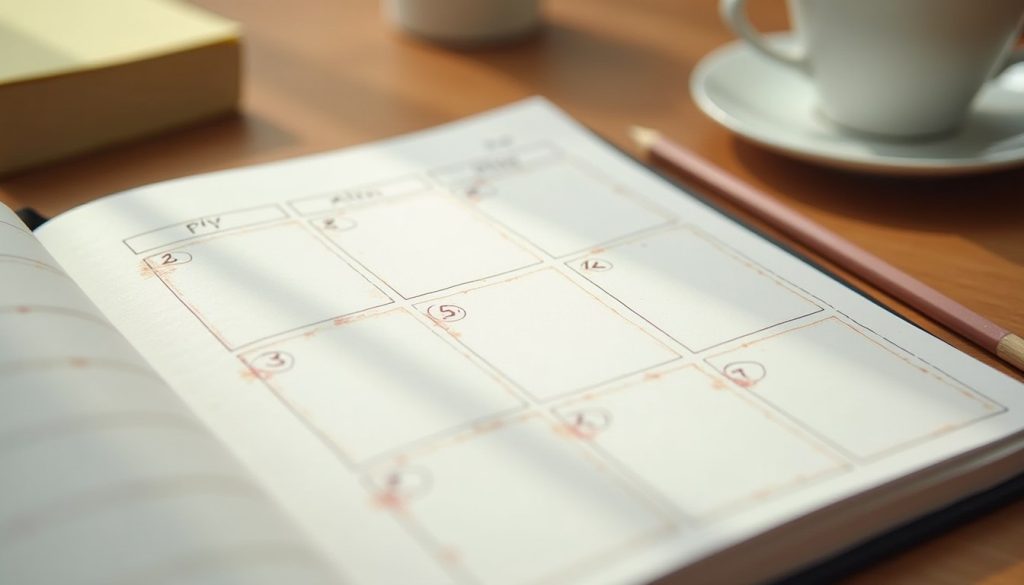
Ten focused minutes of recall beats an hour of rereading, and ten minutes is small enough to survive a bad day. Put the review in the same slot daily — before the commute, after lunch, last thing at night — so the decision to study is not a decision at all. A weekly planner with three fixed review slots does more for retention than any app’s algorithm, because it survives the weeks when motivation does not.
If you are teaching yourself a new skill rather than preparing for an exam, the same cycle applies to practice: attempt, get feedback, wait a day, attempt again from memory or from a blank file. The free courses in learning real skills for free are a good source of material for exactly this loop. Sleep is the other half of the equation, and the routine in evening habits for better sleep is worth pairing with any study plan, because material reviewed before a proper night’s sleep consolidates noticeably better. The research behind retrieval-based study is summarised at RetrievalPractice.org, and the original spacing effect is documented at spaced repetition.