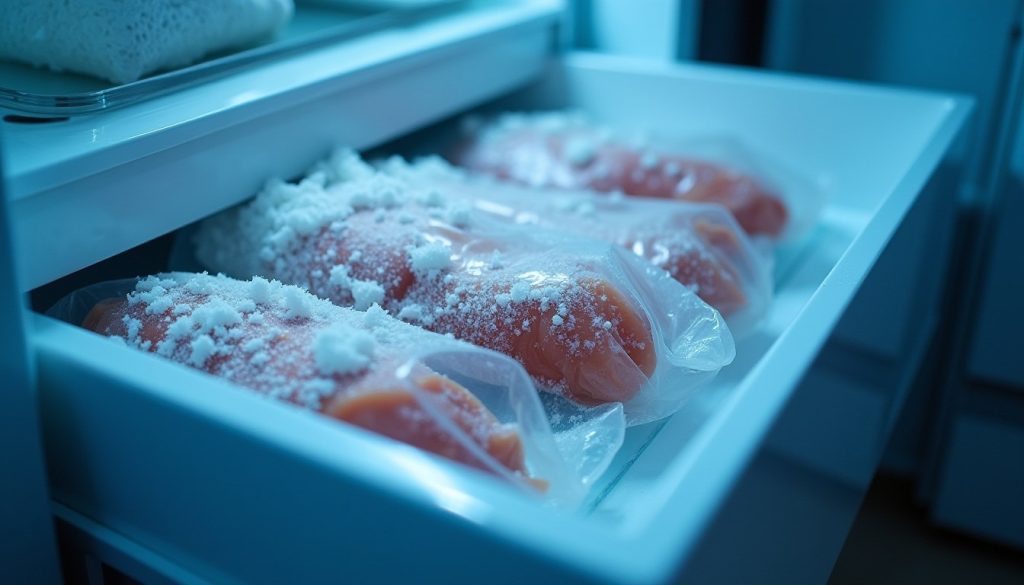
A bag of mince comes out of the freezer with a pale, dry patch on one corner and a smell that is technically fine but not appetising. That patch is freezer burn, and it is the single most common reason edible food goes in the bin. It is not spoilage, it is not dangerous, and almost all of it is avoidable with a change in how you pack things rather than how cold you keep the freezer.
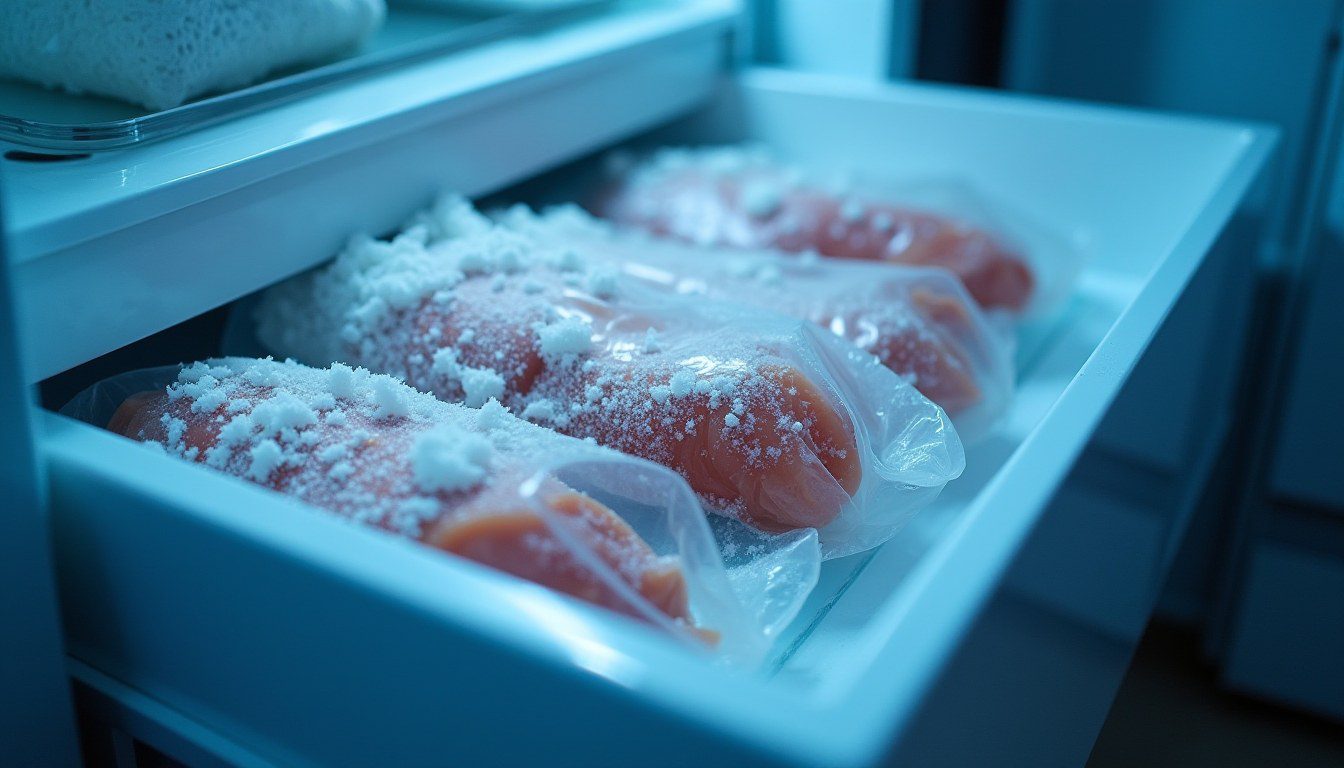
What freezer burn really is
Food is mostly water. In a freezer, that water exists as ice, and ice has a property that matters here: it sublimates. At temperatures well below zero, ice turns directly into vapour without becoming liquid first. The vapour leaves the surface of the food, migrates through the air gap in the packaging, and re-freezes as frost on the inside of the bag or on the freezer wall.
What is left behind is dehydrated tissue — the tough, stringy, pale patch. It is the same process that turns a forgotten ice cube in the back of the freezer into a small, cloudy pebble. The food has not gone bad; it has dried out in the coldest possible way.
Air, not temperature, is the variable you control
Freezers hold a steady temperature or they are broken, and most domestic freezers sit between minus eighteen and minus twenty, which is cold enough for months of storage. What varies is how much air touches the food. Every pocket of air inside a bag is a highway for moisture to leave the surface. A bag sealed with a fistful of air is worse than a bag pressed flat, even though both are “sealed”.
This is why vacuum sealing works so well and why a clip on an open bag does almost nothing. It is also why a rigid container with a good lid beats a thin bag for anything wet: the food cannot shift, so no new air pockets open up.
Pack flat, push the air out, and freeze fast
The method that solves most of this in a domestic kitchen: put portions into a good freezer bag, press the bag flat until the contents are about two centimetres thick, and squeeze the air out from the bottom upwards before sealing. Flat packs freeze quickly because heat leaves through a thin layer, and quick freezing makes smaller ice crystals, which do less damage to texture.
Flat packs also stack like books and thaw in under half the time of a solid lump. For liquids — stock, sauce, cooked rice — a rigid container filled to within a centimetre of the lid leaves no room for air to circulate. For meat, wrap once in cling film pressed against the surface, then bag it; the film stops surface drying, the bag stops the film peeling.
Label with a date you will actually read
Freezer burn is a slow problem that gets solved by rotation, and rotation needs dates. Write the contents and the date on the bag with a permanent marker on the flat side, before it goes in the freezer — writing on a frozen bag is fiddly and usually skipped. Use the format you actually read at a glance: “mince 07/11” beats an elaborate label every time.
Then work on the principle that older food sits at the front and top. If the newest pack is the easiest one to reach, the oldest pack becomes permanent furniture. A simple rule: when you add something, pull the oldest item of the same type forward and plan it into the next two meals.
How long things actually keep
Freezer burn is a quality problem, and quality falls faster than safety. As rough working limits for home freezers: raw mince and poultry two to three months, steaks and chops four to six months, cooked dishes two to three months, bread one to three months, blanched vegetables eight to twelve months, and stock up to six months before the flavour flattens. Beyond those windows food is usually still safe but increasingly disappointing.
Temperature stability matters as much as the number. A freezer that is opened constantly, or filled to the door with nothing behind it, swings in temperature and grows ice crystals faster. Keeping it two-thirds full gives it thermal mass, and a thermometer inside — not the dial on the outside — tells you what it is really doing. Our guide to refrigerator temperature settings covers the same principle for the fridge half of the appliance.
Can you still eat a burnt patch?
Yes. Cut the dry section away and use the rest; it is a texture and flavour defect, not a safety one. Do not refreeze the trimmed portion a second time if it has already thawed, and do not try to “rescue” a badly burnt surface by soaking it — the water makes the texture worse. In mince or stew, a mildly burnt edge disappears once it is browned and sauced. In a steak, it is better trimmed before cooking than served.
Two habits, in the end, do most of the work: squeeze the air out and write the date on. Everything else is detail. If wasted food is a recurring cost in your kitchen, the wider habits in reducing food waste at home and the shopping approach in saving money on groceries without coupons pick up where the freezer leaves off. The underlying mechanics of sublimation and surface drying are set out at freezer burn, and the EPA’s guidance on reducing wasted food puts the household scale of the problem in context.