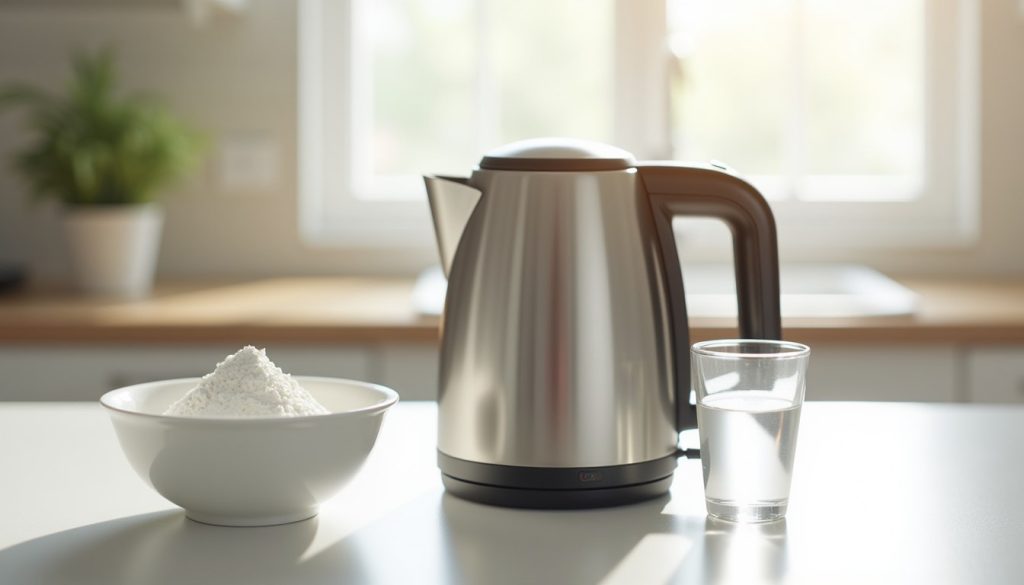
If your tea has started tasting faintly chalky, or you can hear your kettle rattling and taking longer to boil, you’ve got limescale. It’s not dirt. It’s minerals left behind every time water boils off, and it builds up whether or not you clean the outside. The good news is that you can descale an electric kettle in about half an hour with a sachet of citric acid, and it works better and smells better than the vinegar trick most people reach for first.
Where the White Crust in Your Kettle Comes From
Hard water carries dissolved calcium and magnesium. When you heat it, some of those minerals drop out as calcium carbonate, which is the white or beige crust on the element plate and the flaky bits floating in your cup. The harder your water, the faster it forms. Anyone on borehole or groundwater supply tends to notice it first, and hard-water areas including parts of Dhaka groundwater leave a visible layer within weeks.
Scale isn’t just ugly. It acts as insulation between the heating element and the water, so the kettle works harder and longer for the same boil. If you’re already trying to cut standby power waste from your gadgets, a scaled kettle quietly undoes some of that effort every single morning.
Citric Acid or Vinegar: Picking Your Descaler
Both are mild acids that dissolve calcium carbonate. The difference is the side effects.
- White vinegar works, usually diluted 1:1 with water. The trouble is the smell, which hangs around your kitchen while it boils and can linger in the kettle for a couple of brews. Acetic acid can also be harder on rubber lid seals and gaskets if you use it often.
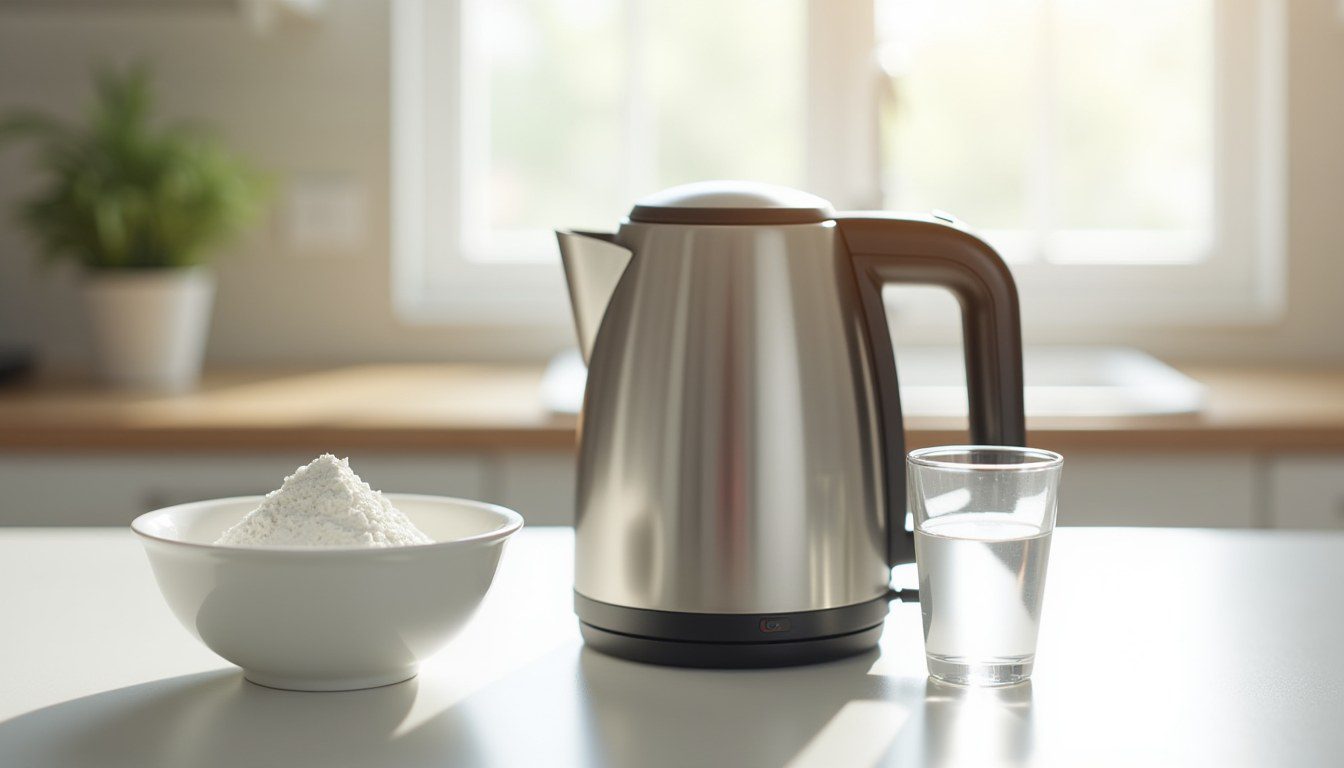
- Citric acid is sold as a dry white powder in supermarkets and baking aisles, and it’s what many branded kettle descaler sachets actually contain. It’s odourless, and the leftover taste rinses out easily.
A practical ratio is about 1 tablespoon of citric acid (roughly 15 g) per 500 ml of water. For a standard 1.7-litre kettle, two to three tablespoons with enough water to sit well above the scale line is plenty. For a thick crust, go a little stronger rather than a lot longer.
How to Descale an Electric Kettle, Step by Step
- Empty and check. Pour out old water and look at how far up the walls the scale goes. That’s your fill target.
- Fill with solution. Add water to just above the scale line, then stir in the citric acid. Don’t fill past the MAX mark.
- Boil once. Switch it on and let it come to the boil. You’ll often see fizzing as the acid hits the scale.
- Soak 20-30 minutes. Leave it switched off and lid closed. Heavy scale may need a second boil and another soak.
- Unplug and scrub. Pull the kettle off its base, pour the solution away, and wipe the element plate with a soft brush or non-scratch sponge. Skip steel wool, which scratches stainless steel and gives new scale somewhere to grip.
- Rinse and boil-and-discard twice. Fill with clean water, boil, pour it away, then repeat. This clears any citric taste before you make your next cup.
The most common mistake is skipping the double rinse boil. One rinse usually clears the taste, but two is cheap insurance.
Don’t Forget the Filter Mesh in the Spout
Most kettles have a small mesh filter clipped inside the spout to catch flakes. It scales up too, and a clogged one makes the kettle pour slowly or spit. Drop it in a cup of the same warm citric solution for 15 minutes, then brush it gently with an old toothbrush and rinse. It’s the same principle as cleaning a washing machine filter: the small trap that nobody looks at is often what’s causing the problem.
How Often to Descale Based on Your Water
How often you need to descale an electric kettle depends on your water hardness and how many times a day you boil. A rough guide:
- Soft water: every 2-3 months, or when you spot a light film.
- Moderately hard water: about once a month.
- Very hard water or groundwater: every 1-2 weeks for a heavily used kettle.
Two habits slow buildup: boil only the water you need, and empty the kettle rather than leaving water standing in it overnight. Boiling only what you need also saves water, and the EPA’s WaterSense program has plenty of other everyday water-saving ideas. If you also run a drip machine, the same citric acid works there; here’s how to descale a coffee maker the easy way.
Safety Rules and Signs the Element Is Finished
Keep it simple and conservative:
- Always unplug or lift the kettle off its base before scrubbing or putting your hand inside.
- Never boil bleach or any chlorine cleaner in a kettle, and never mix it with acid descalers. That combination can release harmful chlorine gas.
- Never immerse the kettle body or base in water. Only the inside gets wet.
- Stainless steel bodies handle citric acid well. Plastic bodies are fine with it too, but stick to a gentler ratio and the shorter soak, and avoid abrasive pads that scratch and cloud the plastic.
Sometimes descaling reveals a kettle that’s simply worn out. Warning signs include black pitting or flaking on the element plate, rust spots, a burning smell, the kettle cutting out before it boils, or tripping your electrics. Those point to a damaged element or faulty thermostat, not limescale, so stop using it and replace it.
Keep a jar of citric acid next to the tea bags, and when the spout mesh looks gritty or the element plate turns from shiny to dull beige, that’s your cue to descale an electric kettle again. Three tablespoons, one boil, a 30-minute soak and two rinse boils, and your next cup tastes like water again.